AI workspace
HGPT
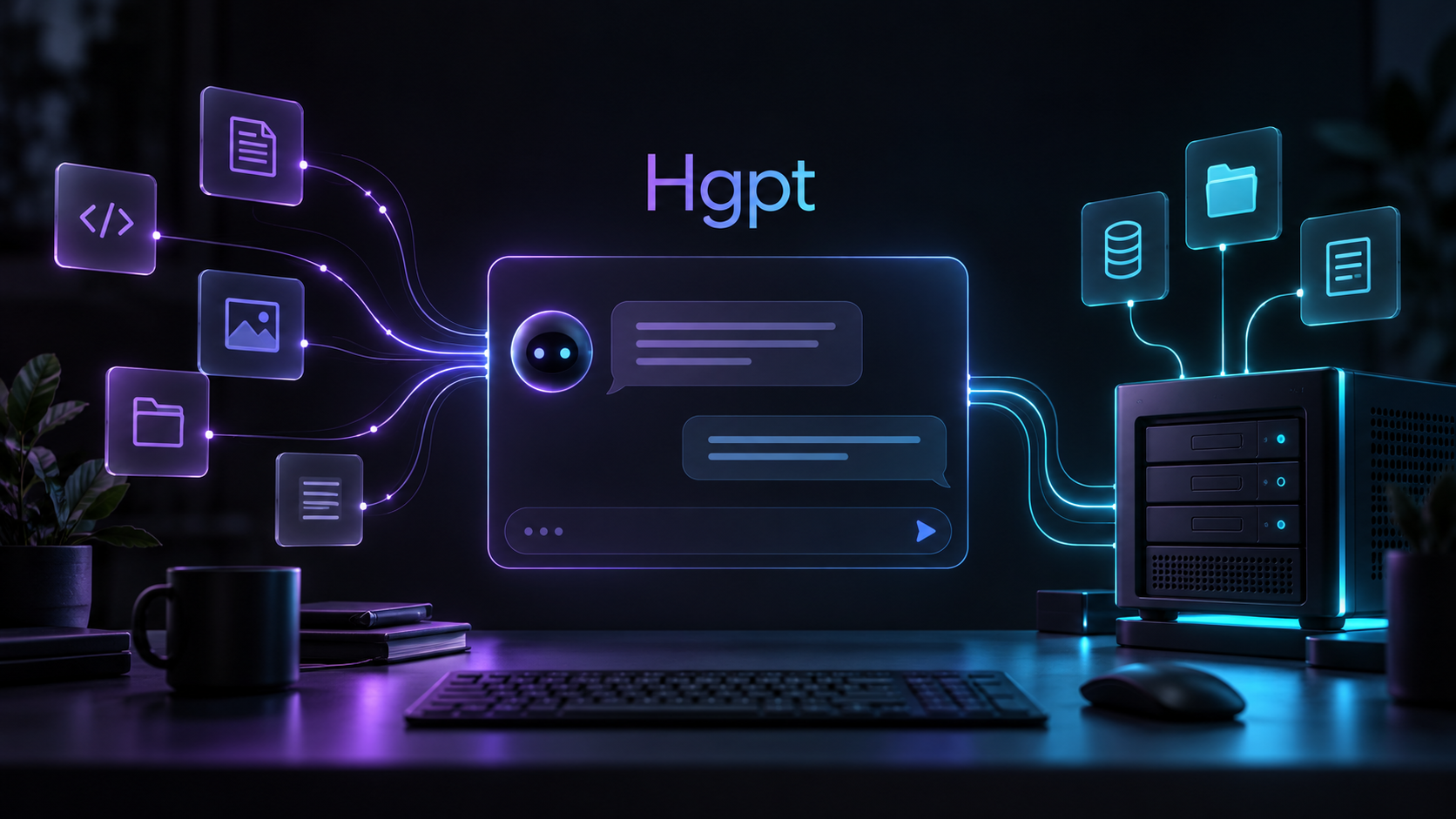
A self-hosted AI workspace where conversations, projects, decisions, and explicit memory remain available even when the selected model changes.
What it is for
A self-hosted AI workspace where conversations, projects, decisions, and explicit memory remain available even when the selected model changes.
AI conversations are usually trapped inside one provider and important context disappears into old threads. HGPT keeps the durable parts in a database you control, then supplies relevant context to whichever supported runtime you choose.
- Keep a long-running project
- Carry project instructions, confirmed facts, and decisions across conversations and model changes.
- Inspect an answer
- Review the recalled context and provider trace rather than treating memory as an unexplained black box.
- Try without registering
- Start an isolated guest workspace and select an available runtime.
Try this project
This is the professional showcase. Visit my playground on myhai.org to try the live app, find downloads, or explore the project.
Try on myhai.orgFeatures and workflow
- One workspace, many runtimes
- Use local Ollama, installed Codex or Claude CLIs, or a configured OpenAI-compatible API without moving the conversation.
- Durable memory
- Save confirmed facts explicitly and connect them to projects, topics, conversations, and decisions.
- Inspectable recall
- See which memories, earlier messages, topics, and provider were used for an answer.
- Project and decision records
- Give long-running work persistent instructions and record choices with rationale, evidence, alternatives, and status.
- Private guest access
- A signed random guest identity creates an isolated workspace without requiring an account.
- Provider controls
- Add compatible providers, validate their model catalogs, and keep saved API keys encrypted.
- Open HGPT and start an isolated guest workspace.
- Choose a local, CLI, or API-backed model.
- Create a project or conversation and add durable instructions when needed.
- Save only the facts and decisions that should persist.
- HGPT retrieves relevant context, sends it to the selected runtime, and records the trace with the response.
Architecture
The interface is vanilla HTML, CSS, and JavaScript. Express assembles context and streams responses; PostgreSQL is the authority for conversations and memory; local embeddings and topic relationships support recall; Redis serves only ephemeral HAI state. Host-authenticated CLI runtimes are reached through a Unix-domain socket rather than copying their credentials into the application container.
Privacy and limitations
Every query is scoped to its signed-in or guest owner. Guest cookies are HTTP-only and SameSite=Strict. Saved provider keys use AES-256-GCM encryption, compatible provider URLs are screened against private-network and credential-bearing targets, and recalled text is labeled as untrusted context rather than executable instruction.
Status
Live on myhai.org and under active development. HGPT is a personal knowledge workspace, not an autonomous truth engine: the user decides what becomes confirmed memory, and model output still needs normal review.
- Availability
- Live web app
- Best for
- Long-running AI work
- Data model
- User-owned PostgreSQL
- Interface
- Responsive web workspace
Questions
Do I need an account?
You can start in a private guest workspace. Keep the same browser identity to return to that workspace.
Does changing models erase my project?
Conversations, explicit memories, and decisions belong to HGPT rather than to one provider. The selected runtime receives relevant context for the next response.
What should I save as memory?
Save facts you have confirmed and want to reuse. Model output and retrieved context can be wrong, so review them before making them durable.